
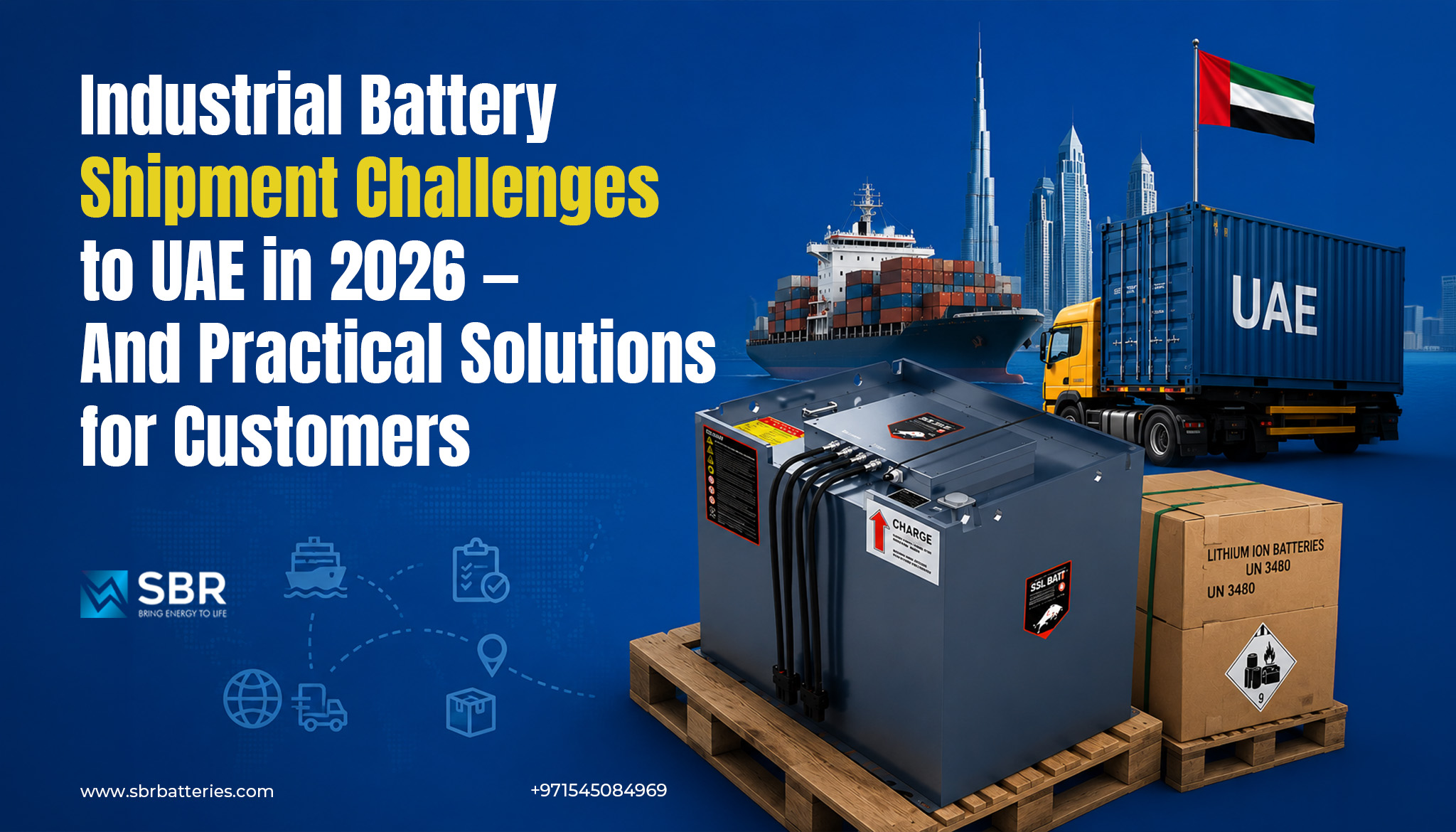
Industrial Battery Shipment Challenges to UAE in 2026 And Practical Solutions for Customers
Delay in battery shipment can cause a great deal of difficulty affecting the operations, uptime and customer commitments. As far as the diverse industries of the UAE such as warehouses, logistics companies, airports, golf resorts, manufacturing plants and cleaning equipment operators are concerned, the timely supply of traction batteries, lithium batteries, chargers and electric material handling equipment are crucial.
However, the present scenario in 2026, with the geopolitical tensions, shipping disruptions, uncertainty around Red Sea route and the overcrowding at major Gulf region logistic hubs/ports are causing delays, higher shipping cost and less predictable delivery times.
As the shipping environment of the Middle East has become increasingly volatile, major carriers are rerouting their vessels, reducing Gulf schedules and avoiding high-risk maritime corridors- causing the slow cargo movement to the UAE ports, higher freight and insurance cost, container shortage, overcrowding of ports, and delay in custom clearance.
Current industrial reports suggest that alternating routing extends the delivery time by 7-14 days, adding to the existing pressure on freight rates and equipment availability.
How do these impact the industrial battery users of the UAE and can this be tackled? Let’s find out.
Common Problems Faced By Industrial Battery Users
Industrial batteries are not general everyday batteries that are available in plenty. They are selected based on the specific equipment and the operation conditions. A delay in their supply can in fact halt the operations entirely. Commonly affected industries include:
- Forklift operations
- Warehousing and logistics
- Airport ground support equipment
- Cleaning machine fleets
- Golf cart and buggy operations
- Port equipment
- Manufacturing plants
- Cold storage facilities
Looking into the problems that customers now face :
1. Longer Lead Times
Battery shipments that used to take 4-6 weeks now need 8-12 weeks due to rerouting.
2. Limited Stock Availability
Commonly used industrial batteries and related products are running out quickly. Due to shipping delays, high demand or supply chain issues, suppliers are not able to replace the stocks fast enough. This causes the certain DIN and BS traction battery sizes, lithium modules and charger components to be temporarily unavailable.
3. Increase in Freight Cost
The landed cost across the supply chain is increasing due to limited vessel availability, war-risk insurance and rerouting costs.
4. Operational Downtime
Delay in battery replacement means the temporary halt of forklifts, cleaning machines and other utility vehicles. This can directly lead to costly downtime.
Practical Solutions for UAE Customers
Although the current challenges are quite a bottle neck, businesses can reduce such operational risk by adapting their battery management strategy:
1. Maintain Battery Stock
This means, instead of going for just-in-time inventory, companies should make sure the following:
- Maintain minimum battery backup
- Stock critical spare connectors and charger parts
- Plan the replacement cycles beforehand
- Keep extra stock of battery watering accessories
2. Shift to Lithium Batteries
Lithium batteries can be a good option for some industries because they require less maintenance and can handle irregular work schedules better compared to the traditional lead-acid batteries. Lithium batteries charge faster, last longer and do not need watering.
3. Refurbish Existing Batteries to Extend Life
Professionally refurbishing or replacing the existing lead-acid batteries can help extend its life during supply shortages. The various services include:
- Cell replacement
- Connector replacement
- Cable refurbishment
- Equalization recovery
- Battery desulfation
- Capacity restoration programs
4. Optimize Charging Practices
Improper charging practices can significantly shorten the battery life. There keep in mind the below aspects:
- Avoid deep discharge
- Maintain correct electrolyte levels
- Use equalization charging
- Do not overcharge the batteries
- Keep batteries in temperature-controlled areas where possible
5. Plan Purchases Earlier
Never wait until battery failure occurs. Make sure to plan purchases beforehand and make sure they are always in stock. You may consider the below aspects:
- Start procurement discussions 2–3 months earlier
- Confirm availability before equipment breakdown
- Secure production slots with suppliers
- Align shipping schedules proactively
Why Supply Chain Flexibility Outweighs Lowest Price
In uncertain logistics conditions as the current situation, opting for a cheap supplier may look like a good option, but may not always be the safe operational choice. Therefore it is important to evaluate the following conditions:
- Local UAE stock availability
- Technical support capability
- Emergency service response
- Spare parts availability
- Warranty support
- Installation support
- Battery refurbishment capability
Conclusion
Despite the current geopolitical tensions, ship rerouting and port congestion, the UAE ports and supply chains are adjusting through the situation by adopting cargo redistribution, emergency logistics corridors and other strategies. Amidst these disruptions, businesses can ensure safe operation by making smart inventory planning, battery refurbishing, adopting the lithium variants and several other proactive measures.
In such uncertain conditions, maintaining operational continuity becomes increasingly important, and businesses that focus on resilience and preparedness today will be better positioned to sustain productivity and customer confidence in the long run.
