
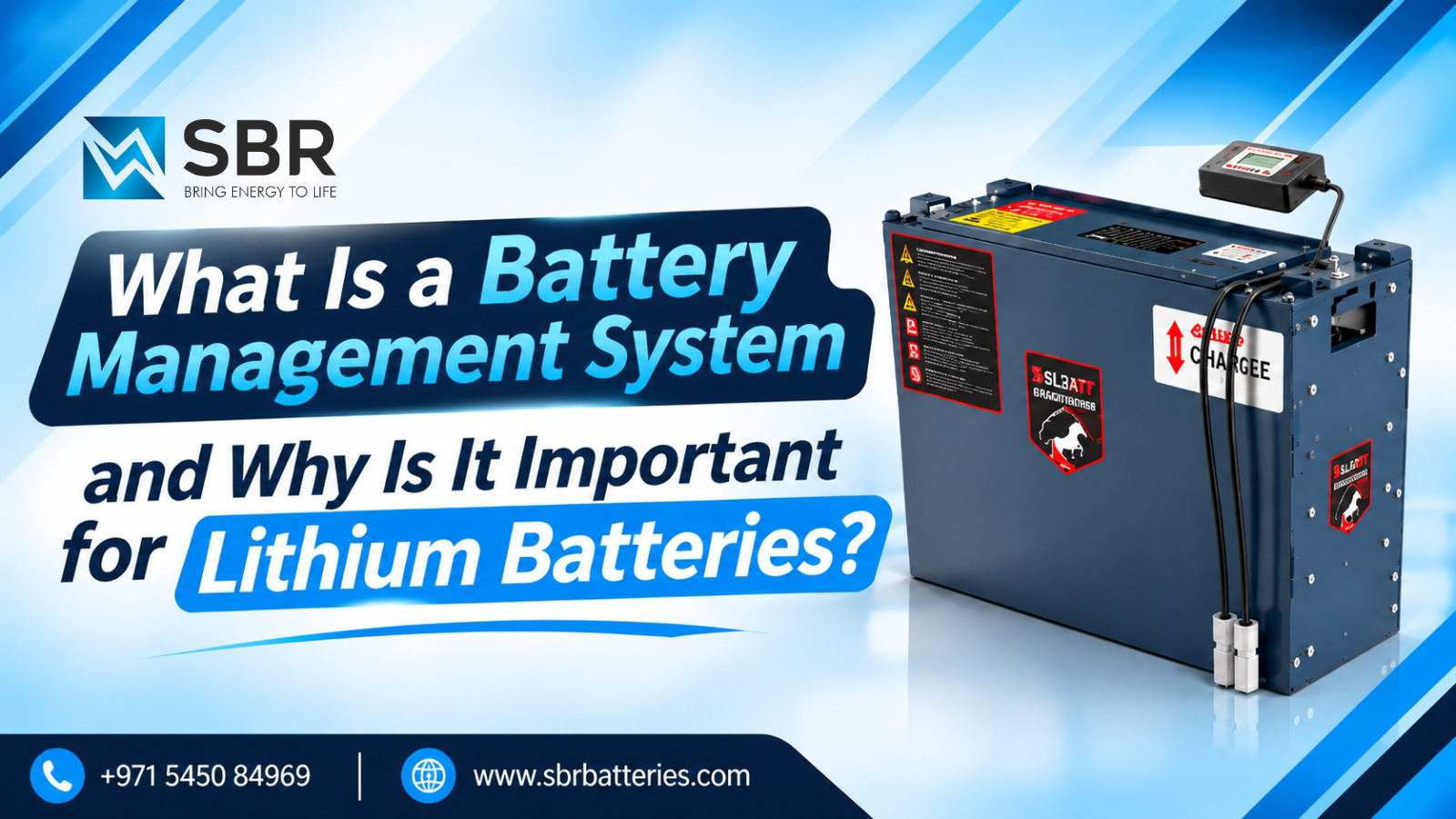
What Is a Battery Management System (BMS) and Why Is It Important for Lithium Batteries?
From forklifts and cleaning machines to solar storage and back up power systems, lithium-ion batteries are used across industrial equipment. That being said, a battery pack contains several cells, so it is important that they stay within the safe limits.
Overcharging, deep discharge or overheating can cause significant damage, which is often why a BMS or Battery Management System is recommended. It helps to monitor battery conditions and operation. If you ask why this is important, just imagine an occasion where the forklifts halt exactly when you are about to lift a component. Such a work interruption can affect the entire day’s productivity.
What Is a Battery Management System?
To put it simply, BMS is an electronic system that monitors a battery pack. Yes, a battery supervisor. It checks individual cells, manages charging and power supply and makes sure that the pack remains within the safe limit.
Battery management systems don’t store energy; instead, they help batteries to use that energy safely. This is important because one weak cell can affect the entire performance of the pack.
How Does a BMS Work in Lithium Batteries?
The sensors of the BMS measure the cell voltage, current flowing into or out of the pack, and the temperature. Then these readings are compared with the battery’s operating limits. If they are normal, charging and discharging can continue. But if the reading exceeds the permitted range, the system automatically limits the power or disconnects the pack, depending on the fault found.
Key Functions of a Battery Management System
A battery management system handles several jobs:
- Voltage monitoring: checks for unusually high or low cell and pack voltage.
- Current monitoring: tracks the current flow.
- Temperature monitoring: checks for unsafe temperature levels.
- Overcharge and over-discharge protection: prevents overcharge and discharge beyond the safe limits.
- Short circuit and overcurrent protection: Interrupts the power supply if a fault is detected.
- Cell balancing: maintained all the cells in similar charge levels.
Why Is BMS Important for Lithium-Ion Battery Safety?
There can be circumstances where you may charge the battery beyond the permitted voltage or use the battery while it is running low. With a battery management system you can monitor the voltage, current, and temperature. At any circumstance of unsafe reading, it stops charging, prevents discharge or disconnects the battery altogether, ensuring safety. That being said, a battery management system isn’t the end solution. Proper installation, a compatible charger, and maintenance are equally important as well.
Understanding SOC and SOH in Battery Management
Don’t let these terms scare you; they mean ‘State of Charge’ and ‘State of Health’, respectively.
The state of charge estimated the remaining charge, while the state of health indicates the battery condition compared to when it was new. As time goes by, batteries age, which can inturn decrease the storage capacity. The BMS estimates both these values using voltage, current, temperature, and battery history. This way, operators get a clear picture of battery condition and runtime.
What Is Battery Cell Balancing and Why Does It Matter?
The cells in the battery pack can develop different charging levels due to use, temperature, or even natural variation. Cell balancing helps to bring these levels closer. There are two types of balancing: active and passive.
Active balancing transfer energy to cells with less charge, while passive balancing releases the excess energy from fully charged cells as heat. Both these methods help to use pack capacity and ensure consistent performance.
This way an individual cell’s malfunctioning won’t affect the entire pack.
Industrial Applications of Lithium Battery Management Systems
BMS-equipped lithium batteries are used across diverse applications such as:
- Electric forklifts and material handling equipment.
- Industrial cleaning machines
- Golf carts and electric vehicles
- Solar energy storage systems
- UPS and backup power systems.
Signs of BMS Problems and the Importance of Proper Maintenance
Yes, even BMS isn’t immune to problems. But how can you detect the issues? Here are a few signs to watch for:
- Unexpected battery solutions: the battery suddenly stops supplying power even when the charge remains.
- Incorrect SOC readings: incorrect battery charge is being displaced.
- Charging interruptions: battery stops charging unexpectedly.
- Warning messages and fault codes: the displays show protection alerts that may be a sign of an operating issue.
That being said, not all signs indicate a faulty BMS. Because loose connections, damaged cables, incompatible chargers, or issues with individual cells can also lead to such symptoms.
Scheduling a battery inspection by a qualified technician is a good option if you notice repeated issues. Always use a compatible charger, follow the manufacturer’s instructions and never disable the BMS to keep it running.
Conclusion
So, why does a BMS matter while choosing a lithium battery? Well, it ensures that the battery is operating within the safe limits, protects individual cells, and gives a clear understanding of the charge level and overall battery condition. As mentioned earlier, a BMS alone doesn’t guarantee efficient battery functioning. You need a good-quality battery with a BMS that is compatible with the equipment and the power requirements.
Are you looking for reliable lithium battery solutions in the UAE? SBR Batteries is here to help you explore the different battery options for industrial equipment and energy storage applications. Contact us today to know more.
