
Is Your VNA Forklift Battery Ready for a High-Performance Distribution Centre?
Busy distribution centers and warehouses need reliable battery power, period. After all, nobody wants the forklifts and other material-handling equipment to stop working in the middle of the shift. Now imagine a VNA truck halting mid-work between the closely placed racks. Not only can it interrupt the work, but it can also affect the smooth movement of goods.
This is why choosing the right traction battery for your VNA forklifts matters. If you are planning to replace your VNA truck battery, you should make sure that the battery matches the forklift’s voltage, capacity, dimensions, and power requirements.
Factors to Consider
Check the Battery Specification
Before buying a battery replacement for your forklift, check the following details to make sure it suits your equipment.
- Voltage and capacity: Check the battery’s rated voltage and ampere-hour capacity.
- Battery dimensions: The new battery should fit inside the existing battery compartment.
- Connectors and cables: Check the connector type, cable arrangement, and polarity.
- Battery weight: Make sure the weight falls within the permitted range. Operating requirements: Check the working hours of the forklift and how often it needs charging.
- Charger compatibility: Ensure the existing charger is suitable for the new battery’s voltage, type and capacity.
As far as VNA equipment is concerned, the batteries must meet more than just the required voltage and capacity. That’s why you shouldn’t miss the above checklist. Also, make sure to refer to the forklift specifications and battery documentation before you choose the replacement.
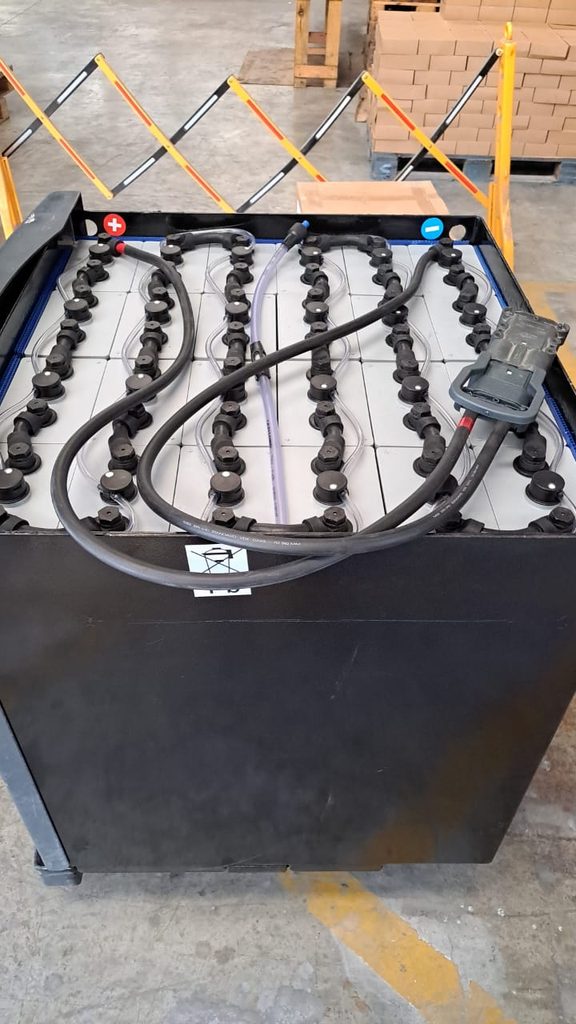
Example: 48V 930Ah Aisle-Master Traction Battery
Are you looking for a replacement battery for your Aisle-Master forklift? Our 48V 930Ah industrial lead-acid traction battery is designed to meet the power requirements of demanding warehouse operations, offering a reliable power solution for your forklifting equipment.
The installation image given above shows the battery’s actual configuration, including the cell connections and watering arrangement, giving our customers a closer look at the model. For further details, contact our team today.
Never Overlook the Charger
Even the most advanced battery can be of no use if it isn’t compatible with the charger. The suitability of the charger depends on the battery’s voltage, capacity, chemistry, and charging requirements. A wrong charger or unsuitable charging setting can adversely affect the battery and even reduce its service life.
Therefore, while you check your existing charging setup, look into these details:
- Charger model, charging settings, and output rating.
- Compatibility with the battery type and capacity.
- Power supply and installation requirements.
- Charging cables and connectors.
- Ventilation and safety of the charging area.
- Whether the charging schedule matches the warehouse’s working shift.
At SBR Batteries, we supply high-frequency industrial chargers, including the GREEN6 range that suits warehouse applications, provided they meet the battery’s charging requirements.
Warning Signs That Your Forklift Battery Needs Attention
So, how do you know when your forklift battery needs inspection? You have to monitor the forklift and battery performance and look out for the following signs:
- Shorter operating time than usual.
- Unusual battery heating.
- Longer charging time.
- Watering issues.
- Inconsistent performance during operation.
That being said, these signs do not always suggest a battery replacement. These problems can also occur due to charger malfunctions, maintenance practices, or operating conditions.
You can always schedule an appointment with a qualified technician to inspect the battery, review the maintenance history, check the voltage and conduct capacity and performance tests to understand its condition.
Lead Acid or Lithium: Which Battery Should You Choose?
Both lead-acid and lithium iron phosphate batteries are used in material-handling equipment. Obviously, they differ in terms of charging requirements, maintenance, weight, upfront cost, and operation characteristics.
If you are planning to switch from a lead-acid battery to a lithium battery, make sure that the forklift supports the new battery technology. You should also consider the battery dimensions, battery management systems, and charger compatibility.
Remember that a lithium battery is not a direct replacement for a lead-acid battery. Make sure that the new battery is suited for your forklift and application.
Consider the Total Cost of Battery Ownership
Yes, the purchase price isn’t the only expense you should consider while choosing a forklift battery. The cost it takes to maintain and operate the forklift throughout its service life should also be considered.
Therefore, make sure to consider factors such as
- Electricity used during charging.
- Regular maintenance requirements.
- Cost of purchasing or upgrading the charger.
- Battery replacement and changeover arrangements.
- Expenses as result of unexpected forklift downtime.
- Expected battery service life.
By comparing these costs with your warehouse’s actual operating conditions, you can make a more informed decision.
Conclusion
Do you need a forklift battery or charger assessment? SBR Motor Batteries Trading LLC offers high-quality industrial batteries, lithium battery solutions, chargers, and maintenance services for warehouse forklifts and other material handling equipment. Contact us today to find the right battery and charger for your forklifts and discuss the requirements with our team.
