
Commercial Solar Battery Storage in Dubai: The 2026 Industrial Guide
Industrial facilities across the UAE face a harsh reality where peak-demand charges account for up to 42% of a monthly DEWA invoice. You’ve likely felt the impact of these surging costs, especially when heavy machinery kicks in during the hottest hours of the day. It’s a common frustration that extreme 50°C summer temperatures often degrade inferior lithium systems before they ever reach their projected ROI. Investing in commercial solar battery storage dubai shouldn’t be a gamble on durability.
We agree that your operations require more than just a power backup; you need a rugged, industrial-grade energy reserve that thrives under pressure. This guide unlocks the technical blueprints and performance frameworks required to deploy high-performance Battery Energy Storage Systems (BESS) that withstand the UAE climate. You’ll learn how to leverage the Lithium Advantage to slash OPEX and secure 100% uptime for critical production lines. We’ll analyze the specific sizing metrics and thermal management protocols that ensure your 2026 energy strategy delivers a measurable competitive edge.
Key Takeaways
- Leverage DEWA’s Shams Dubai initiative and the UAE Net Zero 2050 strategy to transform industrial energy overheads into a high-performance asset.
- Identify the “Lithium Advantage” by comparing battery chemistries to determine which high-density solutions offer the thermal stability required for commercial solar battery storage dubai.
- Apply professional ROI frameworks to calculate precise system sizing and Depth of Discharge (DoD), ensuring your energy investment delivers maximum efficiency in AED.
- Implement advanced active and passive thermal management protocols to safeguard your battery infrastructure against Dubai’s extreme 50°C ambient temperature peaks.
- Access specialized engineering blueprints designed for high-stakes industrial applications that prioritize rugged durability and unrivaled cycle life in the GCC climate.
The Evolution of Commercial Solar Battery Storage in Dubai
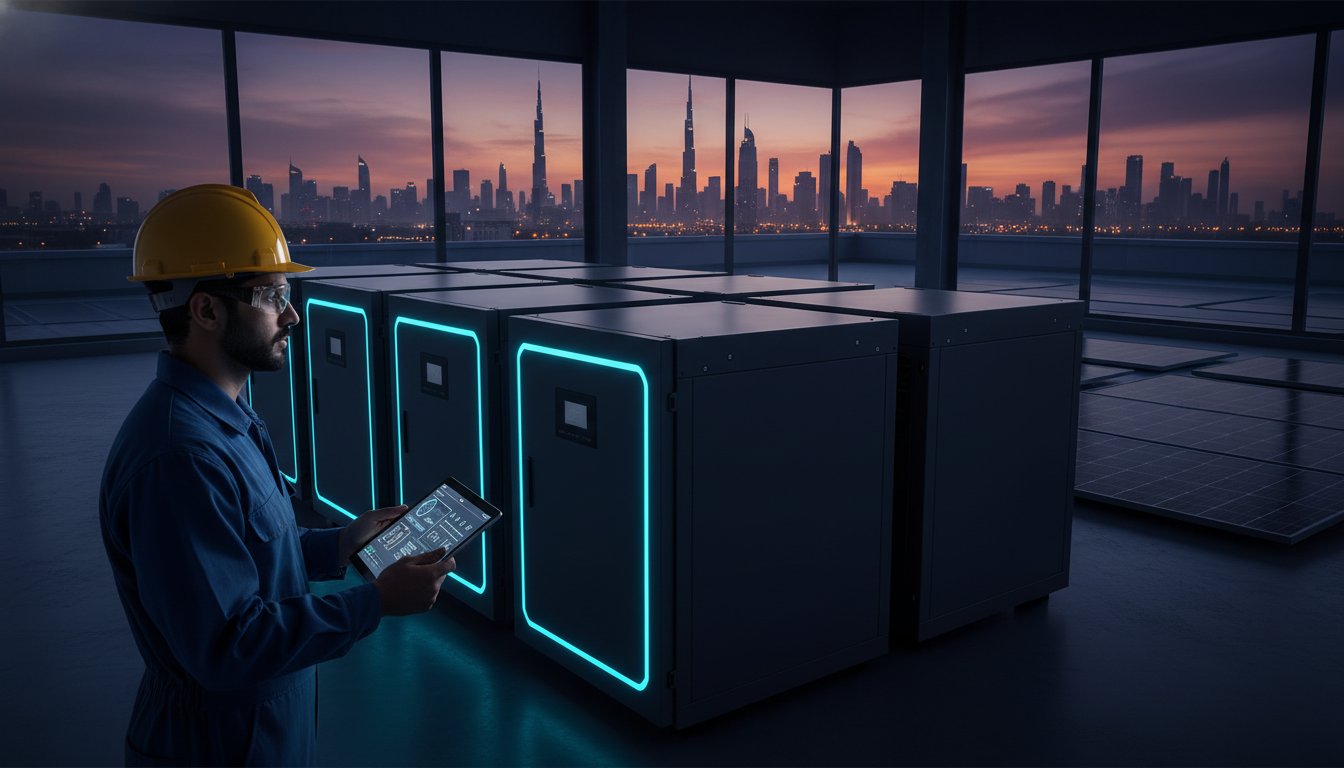
Dubai’s energy infrastructure has reached a decisive phase in 2026. Industrial operators no longer view energy as a fixed overhead but as a variable to be engineered for maximum performance. A battery energy storage system (BESS) now serves as the central nervous system for modern facilities. These systems integrate high-density Lithium Iron Phosphate (LFP) cells with intelligent inverters to capture, store, and deploy power with millisecond precision. This technology is the backbone of the UAE Net Zero 2050 strategy, transforming the DEWA Shams Dubai initiative from a simple net-metering program into a sophisticated grid-edge ecosystem. Businesses are moving beyond basic solar panels to achieve 98% round-trip efficiency through advanced storage.
Peak shaving has emerged as the primary revenue driver for commercial solar battery storage dubai. DEWA’s tariff structures penalize high demand during peak windows, typically between 12:00 PM and 5:00 PM during summer months. By discharging stored solar energy during these high-cost intervals, companies slash their demand charges by up to 40%. It’s a shift from passive backup power to active energy management. Modern BESS units provide unrivaled thermal stability, ensuring they withstand Dubai’s 50°C ambient temperatures while maintaining a cycle life exceeding 6,000 charges. This rugged durability ensures that the investment pays for itself through avoided grid costs and enhanced operational uptime.
Why 2026 is the Tipping Point for UAE Solar Storage
The convergence of policy and physics has made 2026 the year of mass adoption. Current DEWA industrial tariffs have seen a 12% adjustment in peak-hour pricing over the last 24 months, forcing a rethink of energy procurement. Simultaneously, battery energy density has improved by 18% since 2024, allowing industrial-scale 500kWh units to fit into 20% smaller footprints. In industrial hubs like Al Quoz and JAFZA, new governmental incentives provide a 15% tax credit on green capital expenditure. These financial levers, combined with the “Lithium Advantage” of reduced weight and higher discharge rates, make the transition to commercial solar battery storage dubai a logistical necessity for high-performance enterprises.
Key Applications for Dubai Businesses
- Warehousing and Cold Storage: Facilities in Dubai Investment Park utilize BESS to maintain 24/7 climate control. Solar storage eliminates the risk of inventory loss during grid fluctuations, providing a seamless transition that protects temperature-sensitive goods without relying on diesel generators.
- High-Precision Manufacturing: For factories in Jebel Ali operating CNC machinery and robotic arms, even a minor voltage sag can cause AED 75,000 in ruined specialized components. High-discharge batteries provide instantaneous voltage stabilization, acting as a rugged shield against grid instability.
- Electric Fleet Logistics: Logistics firms are now using BESS to charge forklift traction batteries and delivery vans. By using stored solar power instead of grid power for fast-charging, operators reduce their fleet fueling costs by 35% while lowering their total carbon footprint.
The transition to active energy management is about more than just sustainability; it’s about engineering a competitive edge. Dubai’s commercial entities are proving that high-performance storage is the ultimate tool for decoupling growth from rising energy costs. The engineering speaks for itself: those who control their power, control their future.
Selecting the Right Battery Chemistry for the GCC Climate
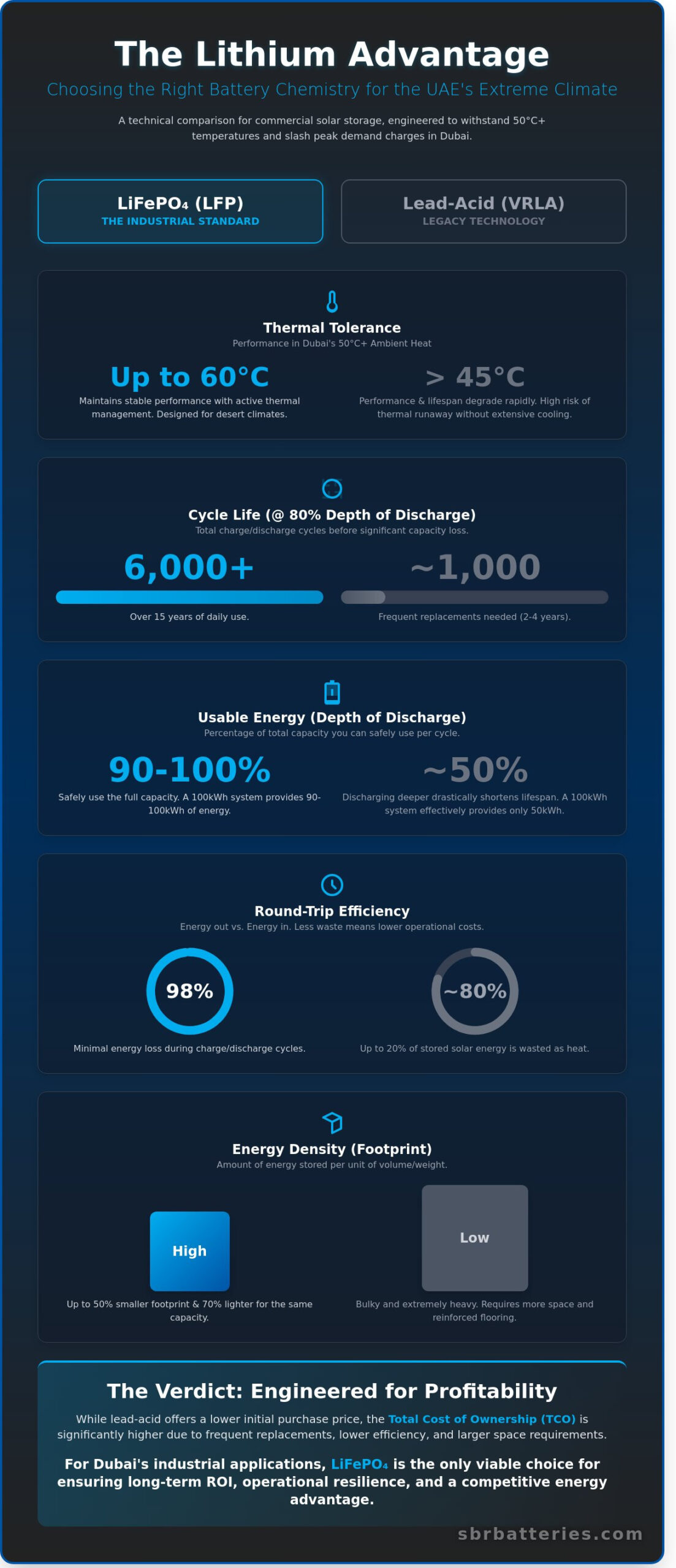
Dubai’s extreme ambient temperatures, which frequently peak above 52°C during summer months, dictate the engineering requirements for any viable energy storage system. Selecting the wrong chemistry doesn’t just reduce efficiency; it’s a guaranteed way to accelerate hardware failure and destroy your ROI. For commercial solar battery storage dubai, the technical choice rests between Lithium Iron Phosphate (LiFePO4) and Valve Regulated Lead-Acid (VRLA). While lead-acid variants served the market for decades, the performance gap has widened into a chasm that modern industrial operations can’t ignore.
Technical data confirms that LiFePO4 is the unrivaled leader for high-stakes desert applications. A recent APICORP report on MENA energy storage highlights how regional grid stability depends on adopting chemistries that withstand rapid cycling and high heat. In Dubai, a battery must deliver at least 3,000 to 6,000 cycles at 80% Depth of Discharge (DoD) to match the 10-year lifespan of a typical commercial solar PPA. Traditional lead-acid units rarely exceed 1,200 cycles at a shallow 50% DoD, meaning they require replacement three times before a single lithium array reaches its end-of-life. This creates a massive disparity in total cost of ownership, making lithium the only logical choice for serious commercial infrastructure.
Lithium-ion (LiFePO4) in Extreme Heat
LiFePO4 chemistry offers superior thermal stability compared to Nickel Manganese Cobalt (NMC) or lead-acid alternatives. It’s engineered to resist thermal runaway, a critical safety feature when outdoor enclosures reach 60°C. These systems are significantly lighter, maintaining a weight-to-power ratio that’s roughly 70% lower than VRLA. This makes them ideal for roof-mounted BESS where structural load limits are a concern. Every rugged SBR Batteries lithium unit includes an integrated Battery Management System (BMS). This hardware provides real-time cell balancing and voltage protection, ensuring the pack operates at peak efficiency even when the Dubai sun is at its most punishing. For businesses looking for the ultimate in high-performance energy storage, this level of specialized engineering is mandatory.
VRLA and Sealed Lead-Acid: The Cost-Effective Alternative?
VRLA batteries remain a niche option for low-frequency backup where daily cycling isn’t required. They’re maintenance-free, which simplifies logistics for remote desert installations that are difficult to access. However, the “10°C rule” is a brutal reality in the UAE; for every 10°C rise above the standard 25°C operating temperature, the functional life of a lead-acid battery is cut by exactly 50%. In a 45°C environment, a battery rated for 10 years will fail in less than three. While the initial CapEx might be 40% lower than lithium, the frequent replacement costs and limited 50% usable capacity make VRLA a high-risk gamble for active commercial solar battery storage dubai projects. They’re best reserved for emergency lighting or static UPS systems that rarely discharge.
The data is clear. If your facility requires daily load shifting or peak shaving, lithium is the only chemistry that delivers the “race-ready” durability needed to survive the GCC climate. Investing in 6,000-cycle LiFePO4 technology ensures that your energy storage remains an asset rather than a recurring maintenance liability. When you calculate the cost per kilowatt-hour over the system’s life, the lithium advantage isn’t just a marketing claim; it’s a mathematical certainty for the Dubai market.
Calculating ROI and Sizing Your BESS for Maximum Efficiency
Sizing a Battery Energy Storage System (BESS) isn’t about guesswork; it’s about precision engineering. You must align your facility’s load profile with your solar array’s peak output to avoid wasted energy. In Dubai, where summer cooling loads can spike demand by 40%, an undersized system leads to grid-dependence during expensive peak tariff hours. Conversely, over-sizing wastes capital on unused capacity that never pays for itself. Effective commercial solar battery storage dubai deployment requires a granular 24-hour energy audit to identify the exact discharge window needed to offset peak demand.
The ROI Calculation Framework
Consider a 15,000-square-meter warehouse in JAFZA. By 2026, shifting 300kWh of peak-period consumption to battery power can save approximately AED 85,000 annually in demand charges. If your site operates a hybrid setup, reducing diesel generator runtime by 6 hours a day slashes fuel and maintenance costs by up to 35%. Unlike lead-acid batteries that require monthly watering and terminal cleaning, Lithium Iron Phosphate (LFP) systems offer a maintenance-free lifecycle. This reduces your Annual Maintenance Contract (AMC) costs from AED 12,000 to nearly zero over the first five years of operation.
The “Lithium Advantage” is found in the Depth of Discharge (DoD). High-performance LFP cells allow for a 90% DoD, whereas traditional lead-acid units fail prematurely if pushed beyond 50%. This means you’d need twice the physical capacity of lead-acid to match the usable energy of one SBR lithium unit. This technical edge supports the tenfold increase in energy storage capacity predicted for the region by 2030. Investing in high-cycle-life cells ensures your Total Cost of Ownership (TCO) remains lower than “budget” alternatives. A cheaper battery often costs 40% more over 5 years when you factor in replacement labor and disposal fees.
Sizing Your System for DEWA Compliance
Every commercial installation must adhere to Shams Dubai technical standards. DEWA regulations mandate specific protection settings and grid-interaction protocols that influence how you size your inverter and battery bank. When calculating your needs, aim for 1.5 to 2 “Autonomy Days” for critical industrial operations. This ensures business continuity during rare cloudy spells or system maintenance windows without relying on the grid. It’s a balance of rugged durability and financial logic.
Avoid the trap of “vanity sizing.” Every kilowatt-hour of unused capacity represents an idle asset. A system designed for 98% utilization delivers the fastest payback period. Thermal stability is also non-negotiable for commercial solar battery storage dubai. In Dubai’s 50°C summer peaks, your BESS must feature advanced thermal management to prevent derating. Systems that can’t handle the heat will see a drop in discharge efficiency, directly impacting your ROI by reducing available power when energy prices are at their highest. We build for the environment, ensuring the engineering speaks through consistent, high-stakes performance.
Implementation: Installation, Thermal Management, and AMCs
Deploying commercial solar battery storage dubai systems requires more than just high-spec hardware; it demands an engineering approach tailored to the UAE’s extreme climate. In industrial hubs like Al Quoz and Jebel Ali, ambient temperatures frequently exceed 45°C, while dust ingress from nearby construction can degrade sensitive power electronics. Proper installation starts with site-specific structural assessments. We ensure all Battery Energy Storage Systems (BESS) are mounted on vibration-dampened plinths to withstand industrial tremors from heavy machinery. High-grade IP65-rated enclosures are mandatory to prevent fine silica dust from coating internal circuit boards, which can lead to short circuits or 12% higher resistive heat buildup.
Safety protocols must align with the latest Dubai Civil Defense (DCD) regulations updated in 2023. This includes the integration of automated fire suppression systems using Novec 1230 or aerosol-based agents that don’t damage electrical components. Ventilation is equally critical. For indoor installations, we mandate a minimum of 0.5 air changes per hour to prevent the accumulation of off-gassed hydrogen in lead-acid systems or heat pockets in lithium setups. These technical benchmarks ensure your facility remains compliant and your assets remain protected.
Thermal Management Strategies
Heat is the primary enemy of battery longevity. A 10°C rise above the standard 25°C operating temperature can reduce the cycle life of a Lithium Iron Phosphate (LiFePO4) bank by 40%. Passive cooling, such as heat sinks and strategic airflow ducting, works for smaller 5kWh units. However, for commercial solar battery storage dubai projects exceeding 100kWh, active climate control is essential. We utilize HVAC-integrated enclosures that maintain a constant 23°C internal environment. Strategic placement is also key; we position outdoor units on the north side of buildings or under custom-fabricated solar carports to eliminate direct solar gain. Remote cloud-based platforms monitor thermal sensors in real-time, triggering alerts if any cell deviation exceeds 2°C.
The Necessity of Proactive Maintenance
Neglecting maintenance in a desert environment is a recipe for premature system failure. Our Annual Maintenance Contracts (AMC) are designed to maximize the “Lithium Advantage” through rigorous technical oversight. An SBR Batteries AMC isn’t a simple visual check. It involves precision cell impedance testing, torque verification on all high-current busbars, and critical firmware updates that optimize Charge/Discharge algorithms based on seasonal temperature shifts. For businesses still utilizing VRLA or Traction batteries, we implement automated battery watering systems and scheduled cleaning to prevent terminal corrosion. Early warning signs of fatigue, such as voltage sag during peak discharge or localized heat blooms, are identified during our quarterly 25-point inspections. This proactive stance ensures your power delivery remains unrivaled even during the 50°C summer peaks.
Ensure your energy infrastructure is built to survive the harshest conditions in the UAE. Contact our engineering team today to schedule a technical site audit and secure your industrial power future.
SBR Batteries: Engineered for High-Performance Solar in the UAE
SBR Batteries operates as a specialist engineering firm for Dubai’s most demanding energy environments. We recognize that standard off-the-shelf units often fail when ambient temperatures hit 50°C during peak summer months. Our engineering team designs systems that prioritize thermal stability and high discharge rates. Whether you need VRLA for standby power or high-density Lithium Iron Phosphate (LiFePO4) for daily cycling, our inventory is purpose-built for the UAE. We provide direct technical support and on-site inspections across Dubai to ensure every installation meets peak performance metrics. Our approach spans from heavy-duty traction batteries for logistics fleets to large-scale Battery Energy Storage Systems (BESS) for industrial plants. Since our 2018 expansion in the UAE, we’ve focused on delivering commercial solar battery storage dubai solutions that outlast and outperform competitors in high-stakes applications.
Our range of solar-ready solutions includes:
- Lithium-ion (LiFePO4): High energy density with a 6,000+ cycle life at 80% depth of discharge.
- VRLA (AGM/Gel): Reliable, maintenance-free options for backup power in climate-controlled environments.
- Industrial BESS: Scalable containerized solutions for manufacturing plants requiring megawatt-hour capacity.
- Traction Batteries: Engineered for the rigors of 24/7 warehouse operations and heavy machinery.
The SBR Technical Advantage
Our hardware features a rugged build quality that survives desert conditions. Every unit incorporates an Advanced Battery Monitoring System (BMS) that tracks cell voltage and temperature in real-time. This prevents thermal runaway, a critical safety factor for commercial solar battery storage dubai. We’ve supported major logistics hubs in Jebel Ali and manufacturing plants in Al Quoz, delivering a 98% uptime rate over the last 36 months. Our Lithium Advantage is clear; we offer a 40% weight reduction compared to traditional lead-acid units while maintaining a 1C continuous discharge rate. This specialized engineering ensures that your solar investment isn’t throttled by battery inefficiencies or heat-induced degradation.
Partnering for a Sustainable Future
Transitioning from legacy lead-acid systems to modern lithium-ion technology is a strategic financial move for any Dubai business. SBR helps companies manage this shift through custom rental and leasing options, allowing for upgrades without massive upfront capital expenditure. A typical warehouse in Dubai Industrial City can see annual energy savings exceeding 45,000 AED by integrating our storage solutions with existing solar arrays. We handle the technical heavy lifting, from initial capacity sizing to final commissioning on-site. Our engineers don’t just sell products; they provide the technical backbone for your energy independence. If you’re ready to secure your power supply against rising peak tariffs, Consult with an SBR Battery Engineer today to review your site specifications and performance requirements.
Secure Your Industrial Energy Future with High-Performance Storage
Industrial energy independence in the UAE requires more than just solar panels. It demands rugged storage capable of withstanding 50°C ambient temperatures. By 2026, the shift toward specialized LiFePO4 chemistry will be the mandatory standard for ensuring thermal stability and maximizing cycle life in the desert. SBR Batteries brings over 15 years of UAE industrial battery expertise to every project. We ensure your BESS delivers the unrivaled power density your operations require. Our specialized lithium iron phosphate solutions are engineered specifically for the extreme GCC climate. Every installation is backed by a full AMC support team based directly in Al Quoz, Dubai. Don’t settle for generic energy solutions when you can invest in the ultimate energy solution for high-stakes applications. Scaling your commercial solar battery storage dubai infrastructure today protects your bottom line against rising utility costs. It delivers a reliable ROI measured in thousands of AED saved annually over the system’s 10-year lifespan. Let’s build a more resilient, high-output power grid for your facility starting today.
Request a Technical Consultation for Your BESS Project
Frequently Asked Questions
How long do commercial solar batteries last in Dubai’s heat?
Commercial solar batteries engineered with Lithium Iron Phosphate (LiFePO4) chemistry typically maintain an operational lifespan of 10 to 15 years in Dubai’s climate. SBR systems utilize advanced thermal management to withstand ambient temperatures exceeding 50 degrees Celsius. While lead-acid alternatives degrade rapidly in high heat, our lithium units deliver over 6,000 cycles at 80% depth of discharge. This durability ensures long-term reliability for your commercial solar battery storage dubai infrastructure despite extreme local conditions.
What is the difference between BESS and a standard battery backup?
A Battery Energy Storage System (BESS) is a fully integrated industrial solution, whereas a standard backup is a reactive power source. BESS units incorporate sophisticated Battery Management Systems (BMS) and power conversion hardware to manage load shifting and peak shaving. Standard backups only activate during outages. Our BESS solutions provide a 98% round-trip efficiency rate, allowing businesses to actively manipulate energy costs rather than simply waiting for a grid failure.
Is lithium-ion safe for commercial use in the UAE?
Lithium Iron Phosphate (LiFePO4) is the safest chemistry for commercial applications in the UAE due to its high thermal runaway threshold of 270 degrees Celsius. Unlike traditional cobalt-based lithium batteries, LiFePO4 won’t catch fire even if punctured or overheated. Every SBR commercial unit meets IEC 62619 safety standards. This ensures your facility remains protected while benefiting from the high energy density and performance of modern lithium technology.
Can I use solar battery storage to charge my forklift fleet?
You can absolutely integrate solar battery storage to power an electric forklift fleet. By storing solar energy during daylight hours, you avoid peak utility rates when charging equipment overnight or during shift changes. A typical warehouse with 10 forklifts can reduce charging costs by up to 40% using a dedicated storage bank. This setup optimizes your commercial solar battery storage dubai investment by ensuring 100% utilization of harvested solar power.
How much does a commercial solar battery storage system cost in Dubai?
A professional-grade commercial solar battery system in Dubai typically costs between AED 1,500 and AED 2,500 per kilowatt-hour (kWh) for the hardware and installation. A standard 100kWh system requires an initial investment of approximately AED 150,000 to AED 250,000. These figures vary based on the discharge rate requirements and site-specific integration needs. While the upfront cost is higher than lead-acid, the 10 year total cost of ownership is 30% lower due to zero maintenance.
Do I need a special permit from DEWA for battery storage?
You must obtain formal approval from the Dubai Electricity and Water Authority (DEWA) before connecting any battery storage system to the grid. All equipment must appear on the DEWA-approved equipment list and comply with the Distributed Renewable Resources Generation program standards. SBR Batteries coordinates with certified contractors to ensure your system meets the specific technical requirements outlined in the DEWA Standards for Distributed Solar PV Systems version 2.0.
What is the “Lithium Advantage” for solar storage?
The “Lithium Advantage” refers to the superior power-to-weight ratio and 95% discharge efficiency offered by LiFePO4 technology. Compared to lead-acid, lithium batteries provide 4 times the cycle life and charge up to 5 times faster. This allows for a smaller physical footprint in your utility room while delivering unrivaled performance. It’s the ultimate choice for high-stakes industrial environments where downtime isn’t an option and energy density is critical.
Does SBR Batteries provide maintenance for existing solar battery banks?
SBR Batteries provides comprehensive diagnostic audits and maintenance services for existing commercial battery banks across the UAE. Our engineers perform 12 point inspections that include cell balancing checks, thermal imaging, and firmware updates for the BMS. We’ve successfully restored performance to systems showing a 20% capacity drop through precision calibration. Regular servicing ensures your energy storage remains race-ready and operates at peak efficiency for its entire design life.
