
The Ultimate Guide to Traction Batteries: Powering UAE Logistics in 2026
In the peak of the UAE summer, a single forklift failure in a JAFZA warehouse can trigger over 15,400 AED in lost operational revenue per day. When ambient temperatures hit 50°C, your fleet’s energy storage isn’t just a component; it’s a critical point of failure. You understand that maintaining a consistent workflow requires hardware that refuses to quit. Every hour of unexpected downtime represents a direct hit to your bottom line, especially when multi-shift demands push equipment to its thermal limits. Choosing the right traction battery is the difference between unrivaled performance and a logistical bottleneck.
We’ll help you master the technical specifications, thermal stability requirements, and ROI calculations necessary to optimize your electric fleet for 2026. You’ll learn how to extend cycle life by up to 40% and drastically reduce maintenance overheads through the Lithium Advantage. This guide provides a clear, data-driven roadmap to transitioning your power systems for maximum efficiency and rugged durability in the Middle East’s harshest environments.
Key Takeaways
- Identify the critical performance differences between Lead-Acid and Lithium Iron Phosphate (LiFePO4) to optimize your fleet’s energy density and uptime.
- Learn technical strategies to protect power units from the UAE’s extreme 40°C+ temperatures and prevent accelerated grid corrosion.
- Discover how to maximize cycle life through precision maintenance protocols and the implementation of automated watering systems.
- Analyze the Total Cost of Ownership in AED to secure a high-performance traction battery solution that delivers unrivaled long-term ROI.
- Evaluate the strategic operational savings available by switching to motive power technologies engineered for the future of Middle East logistics.
What is a Traction Battery? The Core of Motive Power
A traction battery is a high-capacity energy storage unit specifically engineered to provide the motive power required to propel electric vehicles over extended shifts. Unlike an automotive starter battery, which delivers a short, high-current burst to crank an internal combustion engine, a traction battery acts as the primary fuel source. In the high-intensity logistics hubs of the UAE, such as the Jebel Ali Port or the industrial warehouses of Al Quoz, these units are the backbone of 24/7 operations. They don’t just start a machine; they drive it.
Industrial machinery like forklifts, reach trucks, and electric buggies rely on these powerhouses to function. An electric vehicle battery designed for traction must withstand the rigorous demands of heavy lifting and constant movement. In the UAE market, where ambient warehouse temperatures can exceed 45°C, the engineering quality of these batteries determines the efficiency of the entire supply chain. From golf carts at luxury resorts in Abu Dhabi to heavy-duty reach trucks in Dubai South, motive power is what keeps the economy moving.
The Mechanics of Deep Cycle Discharge
Traction batteries are built for endurance. They provide sustained electrical current over a full 8-hour shift, maintaining voltage stability even as capacity depletes. The most critical metric for performance is Depth of Discharge (DoD). While a standard battery might fail if drained significantly, a high-quality traction unit is rated for an 80% DoD. This allows operators to utilize the vast majority of the total capacity before recharging without damaging the internal lead plates or lithium cells. A traction battery is a specialized deep-cycle unit designed to withstand constant 80% discharge cycles throughout its service life. This capability allows a 1,500kg forklift to maintain peak torque from the start of the morning shift until the final pallet is moved.
Motive Power vs. Stationary Power
It’s a mistake to confuse motive power with stationary power systems like VRLA batteries used in solar arrays or UPS backups. Stationary batteries remain in a fixed position and provide emergency power during outages. Traction units are mobile and rugged. They must handle constant vibrations, shocks from uneven warehouse floors, and the physical stress of rapid acceleration and braking. The internal construction features thicker plates and reinforced casing to prevent mechanical failure under these conditions. The “Lithium Advantage” in newer models further enhances this by offering a superior weight-to-power ratio, which is critical for maintaining machine agility.
When evaluating specifications for a fleet in the UAE, you’ll focus on two primary values: Ampere-hours (Ah) and Volts (V). These aren’t just numbers; they define your operational limits.
- Ampere-hours (Ah): This measures the total energy capacity. A 625Ah rating indicates the battery can deliver 125 amps for 5 hours.
- Volts (V): This determines the power output. Most industrial forklifts in the UAE operate on 24V, 48V, or 80V systems.
Choosing the right combination ensures your equipment has the race-ready power needed to handle the 15 million TEUs processed annually at Jebel Ali without mid-shift failure. Professional fleet managers prioritize these technical specs to ensure their investment delivers unrivaled longevity in the harsh Middle Eastern climate.
Lead-Acid vs. Lithium-ion: Choosing the Right Chemistry
Selecting the correct traction battery chemistry determines your facility’s operational ceiling and long-term overhead. For decades, the flooded lead-acid battery served as the industrial workhorse across Dubai and Abu Dhabi. It relies on a 150-year-old chemical reaction between lead plates and sulfuric acid. While the technology is mature, the shift toward Lithium Iron Phosphate (LiFePO4) is accelerating in the UAE. Logistics providers are moving away from legacy systems to capture higher energy density and superior thermal stability. Understanding the advantages of traction batteries in modern industrial settings requires a deep dive into how these chemistries handle the rigors of high-ambient temperatures and multi-shift demands.
The Lead-Acid Advantage and Limitations
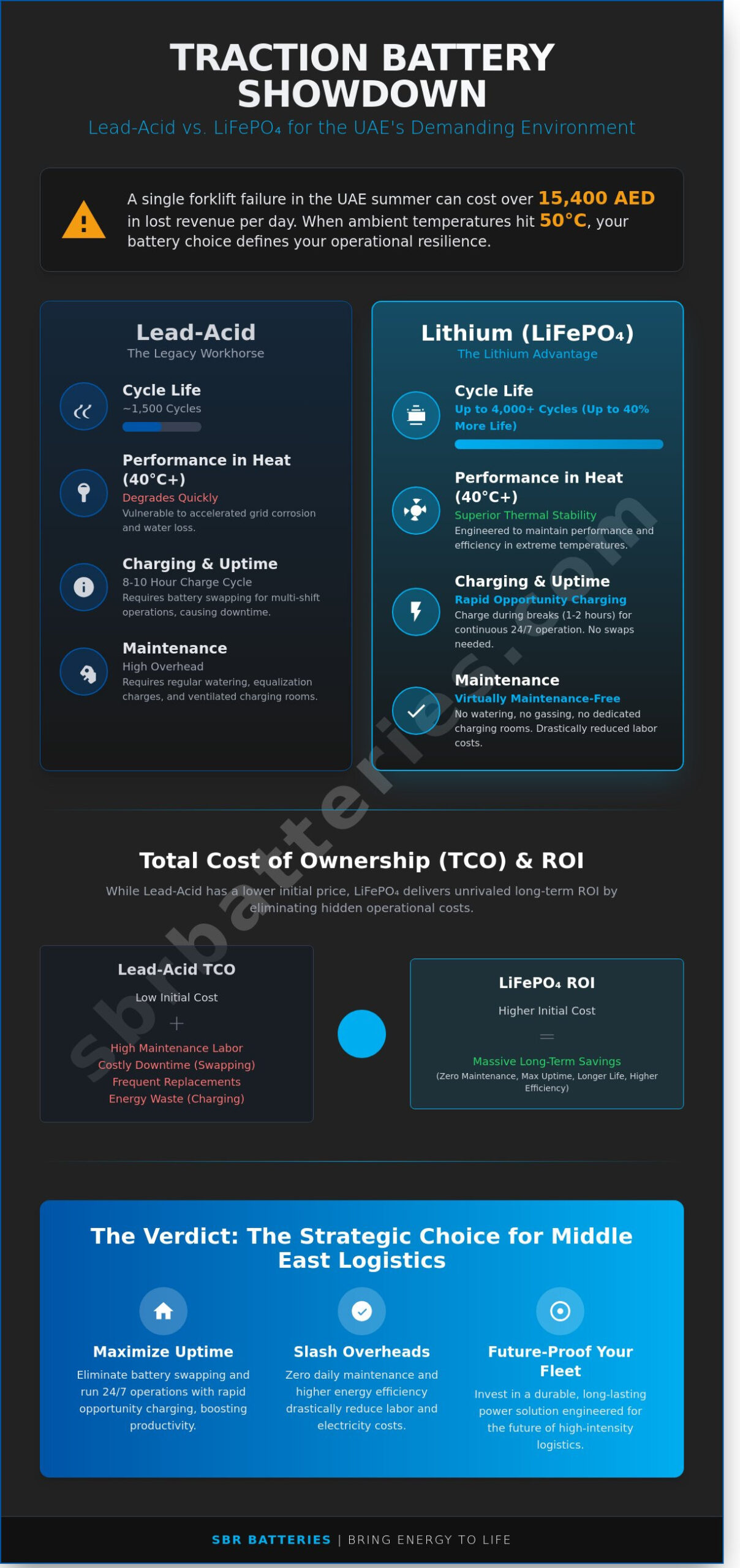
Lead-acid technology remains relevant primarily due to its low initial capital expenditure. A standard 48V lead-acid unit typically costs 40% less upfront than its lithium counterpart. It’s a heavy, rugged solution that often doubles as a necessary counterweight for forklifts. However, the hidden costs are substantial. These batteries require strict adherence to the 8-8-8 rule: 8 hours of work, 8 hours of charging, and 8 hours of cooling. This cycle is non-negotiable because lead-acid batteries lose roughly 30% of their energy as heat during the charging process. If you don’t allow for the cooling phase, the internal components degrade rapidly.
Maintenance is the primary operational bottleneck. Fleet managers must account for weekly “watering” to replenish electrolyte levels and periodic equalization charges to balance cell voltages. In the UAE, the “gassing” phase is a critical safety concern. As the battery reaches full charge, it releases hydrogen gas. This necessitates dedicated, climate-controlled charging rooms with high-volume ventilation systems to meet local safety regulations. For a warehouse operating 50+ trucks, the real estate required for these charging bays represents a significant loss of storage capacity.
The Lithium Advantage for UAE Logistics
Lithium Iron Phosphate (LiFePO4) has emerged as the pinnacle of traction battery engineering for high-stakes environments. The most immediate benefit is the elimination of maintenance. There’s no watering, no cleaning of acid spills, and no dedicated charging rooms. LiFePO4 cells are hermetically sealed, meaning they don’t off-gas during the charge cycle. This allows chargers to be placed at the point of use, reclaiming valuable warehouse floor space for inventory. For UAE businesses, the thermal stability of LiFePO4 is a decisive factor. These batteries operate efficiently at internal temperatures up to 60°C, a threshold where lead-acid performance begins to plummet.
The charging profile of lithium provides a massive competitive edge through “opportunity charging.” Instead of the rigid 8-hour blocks required by lead-acid, lithium batteries can be plugged in during 15-minute breaks or 30-minute lunch shifts. A typical LiFePO4 system can reach a 50% charge in just 30 minutes. This capability enables 24/7 multi-shift operations with a single battery per truck, eliminating the need to purchase and store spare battery sets. While the initial price tag might be higher in AED, the total cost of ownership is often 30% to 50% lower over a five-year period due to the 3,000+ cycle life and 95% energy efficiency. If you’re ready to upgrade your fleet’s output, you can explore high-performance lithium solutions designed for extreme industrial use.
Energy density is the final piece of the performance puzzle. Lithium-ion provides roughly triple the energy of lead-acid in the same physical footprint. This allows for lighter battery packs or higher capacity within the same compartment. In a heavy-duty application where every kilogram of weight and every minute of uptime impacts the bottom line, the move to lithium isn’t just a trend; it’s a technical necessity for modern UAE infrastructure.
Maximizing Performance in the UAE Climate
UAE industrial operations face a brutal reality. Ambient temperatures reaching 50°C in industrial zones like JAFZA or ICAD aren’t outliers; they’re daily operational hurdles that dictate the lifespan of your power source. Heat acts as a relentless catalyst for internal chemical reactions. For every 8°C rise above the standard 25°C operating threshold, the service life of a lead-acid traction battery effectively drops by 50%. This thermal degradation isn’t just a theoretical concern; it’s a direct hit to your bottom line through premature replacement costs and equipment downtime.
When internal temperatures exceed 40°C, the positive grid in lead-acid cells undergoes accelerated oxidation. This corrosion thins the grid wires, increasing internal resistance and eventually leading to structural failure. Detailed U.S. Department of Energy battery research underscores how thermal stress impacts various chemistries, emphasizing the necessity of robust thermal boundaries in high-output applications. In the humid summer months, the risk of “dry out” increases. While humidity might seem like it would prevent evaporation, the high ambient heat forces the battery to vent gases more frequently, depleting the electrolyte levels and exposing the lead plates to air, which causes permanent sulfation.
Thermal Management Systems
Modern SBR units utilize integrated heat sinks and high-flow cooling fans to dissipate thermal energy during heavy discharge cycles. The Battery Management System (BMS) acts as the central intelligence, monitoring internal thermistors in real-time. If a cell exceeds 55°C, the BMS throttles output to prevent thermal runaway. We specify “tropicalized” builds for the GCC market. These units feature high-temperature separators and reinforced casing materials that maintain structural integrity even when the warehouse floor hits 45°C. This specialized engineering ensures the “Lithium Advantage” remains intact, providing unrivaled thermal stability compared to standard off-the-shelf units.
Operational Adjustments for Summer
Fleet managers must pivot their workflows during the UAE summer to protect their investment. Charging should occur between 10:00 PM and 6:00 AM when ambient temperatures are at their lowest. We recommend adjusting the electrolyte specific gravity to 1.240 or 1.250 for lead-acid systems operating in the UAE. This lower concentration reduces the corrosive impact on the lead plates during the peak heat of August. Don’t pull a traction battery straight from the charger to the forklift. A mandatory 120-minute cool-down period after a full charge cycle is non-negotiable. This allows the core temperature to stabilize, preventing the “heat stacking” effect that destroys cells during double-shift operations.
- Weekly Fluid Audits: Check electrolyte levels every 7 days during summer, regardless of usage intensity.
- Ventilation Requirements: Ensure charging bays have a minimum airflow of 5 meters per second to strip heat from the battery casings.
- Voltage Regulation: Lower the float charge voltage by 0.003V per cell for every degree above 25°C to prevent overcharging.
Rugged durability in the desert doesn’t happen by accident. It’s the result of precise engineering and disciplined maintenance. By implementing these thermal safeguards, you ensure your equipment delivers race-ready power even when the UAE sun is at its most aggressive. Efficiency isn’t just about speed; it’s about surviving the environment.
Traction Battery Maintenance and Management
Operational efficiency in UAE warehouses depends on the health of the traction battery fleet. In high-heat environments like Dubai Investment Park or JAFZA, where ambient temperatures in non-climatized facilities often hit 48°C, lead-acid units face accelerated evaporation and plate sulfation. Neglecting maintenance protocols leads to a 30% reduction in total cycle life. Professional management involves strict adherence to charging schedules, physical inspections, and precise electrolyte balancing. You can’t treat these units as “set and forget” components. They’re the heartbeat of your material handling operation.
The Importance of Battery Watering
Water loss is an unavoidable byproduct of the charging process. When a traction battery reaches the gassing stage, electrolysis breaks down water into hydrogen and oxygen gases. This process concentrates the sulfuric acid, eventually exposing the lead plates to air and causing permanent oxidation. Using local tap water is a critical error that voids warranties. UAE tap water contains high mineral content that poisons the battery cells through trace metal accumulation. Automated single-point watering systems eliminate human error by delivering precise volumes to every cell simultaneously. Implementing these systems reduces labor costs by approximately 420 AED per battery rack per month while preventing dry cell failures that cost thousands to repair.
Fleet Management and Rotation
Effective management requires a disciplined “first-in, first-out” (FIFO) rotation strategy. Without a structured queue, operators tend to grab the most convenient battery, leading to some units being over-cycled while others sit idle and suffer from self-discharge. Data from high-volume logistics sites suggests that uniform rotation extends the average fleet lifespan by 16 to 20 months. Tracking cycle counts is the only way to move from reactive to predictive maintenance. Standard lead-acid units are typically rated for 1,500 cycles at an 80% depth of discharge. By monitoring these metrics, fleet managers can budget for replacements 6 months before a terminal failure occurs. For detailed technical protocols on maximizing your investment, consult our Guide to Traction Battery Maintenance.
Real-time Battery Monitoring Systems (BMS) provide the data backbone for modern industrial fleets. These sensors track voltage deviations and thermal spikes across every unit in the warehouse. If a unit exceeds 52°C during a fast-charge cycle, the BMS sends an immediate alert to the floor manager. This prevents thermal runaway and protects the structural integrity of the battery casing. Safety protocols must be enforced with zero tolerance. Industrial batteries weigh between 600kg and 2,200kg, requiring specialized hydraulic extraction equipment. Every charging bay in the UAE must be equipped with acid-resistant PPE, eyewash stations, and neutralizing agents to comply with local civil defense safety standards. It’s about protecting your personnel as much as your equipment.
Upgrade to SBR high-performance traction solutions today.
Calculating ROI: Why SBR Batteries is the Strategic Choice
Smart fleet management in the UAE depends on looking past the initial invoice. While a standard lead-acid traction battery might seem cost-effective at the point of purchase, its five-year Total Cost of Ownership (TCO) often hides a massive financial drain. In a typical Dubai logistics hub, operational costs like distilled water, specialized labor, and energy waste can inflate the price of lead-acid power by over AED 40,000 per unit across its life cycle. SBR Batteries shifts this dynamic by prioritizing engineering that slashes operational expenditure (OPEX) from day one.
Our analysis of the UAE market shows that businesses often overlook the cost of downtime. Conventional batteries require eight hours to charge and an additional eight hours to cool down. Lithium-ion technology eliminates the cooling phase entirely, reclaiming 33% of your operational window. When you factor in the high cost of warehouse floor space in areas like JAFZA, dedicating room for “battery charging bays” is an expensive inefficiency. SBR’s high-density power solutions allow for opportunity charging, meaning your equipment stays on the floor where it generates revenue.
- Energy Efficiency: Lead-acid systems lose roughly 20% of their energy as heat during charging. SBR’s lithium solutions operate at 95% efficiency, directly lowering monthly DEWA bills for large-scale operations.
- Maintenance Contracts: Our Annual Maintenance Contracts (AMC) provide scheduled inspections that prevent premature cell failure. This is a critical service given that UAE summer temperatures often exceed 45°C, which can accelerate chemical degradation in unmonitored cells.
- Downtime Reduction: By switching to SBR, companies report a 15% increase in fleet availability because they no longer wait for battery swaps or cooling cycles.
Lead-Acid vs. Lithium ROI Framework
Labor costs represent the largest hidden variable in UAE warehouse management. Managing a lead-acid traction battery fleet requires roughly 150 man-hours per year for watering, cleaning, and acid leveling. Lithium-ion technology removes this requirement entirely, allowing your team to focus on moving cargo. You’ll see immediate gains in electricity efficiency because lithium-ion charging produces negligible heat compared to the high resistance of lead-acid plates. Lithium-ion can offer a 30-50% lower TCO over its lifespan despite higher entry cost. This framework ensures that your capital investment translates into sustained profit margins rather than recurring maintenance debt.
Partnering with SBR for Industrial Power
SBR Batteries delivers a no-nonsense engineering approach that values raw data over marketing hype. We don’t just sell hardware; we provide technical support and on-site inspections across Dubai to ensure your power systems meet specific cycle life targets. Our engineers understand the “Lithium Advantage” and how to apply it to the most demanding industrial environments. For businesses facing seasonal logistics surges, we offer flexible rental and leasing options to scale capacity without heavy capital expenditure. We analyze your duty cycles to recommend the exact chemistry and capacity required for your specific environment. Request a performance audit for your fleet today to see how our rugged, high-performance solutions can redefine your bottom line.
Dominating the 2026 Logistics Landscape with Superior Motive Power
The roadmap to 2026 demands more than standard equipment; it requires a high-performance traction battery engineered for the UAE’s 50°C peak temperatures. We’ve established that SBR’s specialized LiFePO4 solutions offer a 3,500 cycle life, outperforming traditional lead-acid alternatives by 300% in thermal stability tests. Reliability isn’t a luxury when your ROI depends on 99.9% fleet uptime across JAFZA or KIZAD. Our UAE-based technical support team provides immediate on-site assistance, ensuring your operations never stall. By implementing our comprehensive Annual Maintenance Contracts (AMC), you secure a 25% reduction in long-term operational costs through proactive cell balancing and thermal monitoring. Don’t let outdated energy storage throttle your growth in the region’s competitive industrial zones. Our engineers are ready to optimize your fleet’s output with rugged, race-ready technology that delivers unrivaled power density. It’s time to transition your fleet to the pinnacle of battery engineering and secure your competitive edge.
Consult with an SBR Specialist for your custom Motive Power solution
We’re excited to help you lead the charge toward a more efficient and powerful future for UAE logistics.
Frequently Asked Questions
How long does a traction battery typically last in the UAE?
A standard lead-acid traction battery typically lasts 1,500 cycles, which equates to 5 years of operation in UAE industrial environments. High-performance lithium-ion units extend this lifespan to 3,500 cycles or 10 years of service. Ambient temperatures exceeding 35°C accelerate chemical degradation, potentially reducing service life by 25% if cooling protocols aren’t followed. Proper thermal management ensures you reach the maximum rated engineering life of the unit.
Can I replace my lead-acid forklift battery with a lithium-ion one?
You can replace lead-acid units with lithium-ion technology, provided you account for the weight differential. Lithium batteries are 60% lighter, so you must install ballast to maintain the forklift’s center of gravity and lifting capacity. This transition eliminates maintenance tasks like watering and provides a 95% energy conversion efficiency. Most modern UAE industrial fleets are shifting to this “Lithium Advantage” to reduce downtime by 40%.
What is the difference between a traction battery and a deep cycle battery?
Traction batteries are engineered for high-amperage output to drive electric motors; whereas standard deep cycle batteries support steady, lower-current discharges. A traction battery utilizes thicker, reinforced lead plates to withstand 80% depth of discharge daily. While both are deep-cycle by nature, the traction variant is built for the high-stakes mechanical stress of industrial propulsion. This rugged construction ensures the battery maintains its voltage under heavy load.
How often should I water my lead-acid traction battery in Dubai?
You should inspect and water your lead-acid traction battery once every week or after every 5 to 10 charging cycles. In Dubai, where summer temperatures hit 45°C, electrolyte evaporation occurs 20% faster than in temperate climates. Always add distilled water after the charging process is complete to prevent acid overflow. Maintaining the 10mm level above the plates prevents permanent sulfation and ensures thermal stability during operation.
Why is my traction battery losing capacity faster in the summer?
High ambient temperatures in the UAE accelerate internal chemical reactions, causing a 50% reduction in battery life for every 10°C rise above 25°C. Heat increases the rate of self-discharge and grid corrosion within the cells. If your battery reaches internal temperatures of 50°C during a shift, its capacity will drop significantly. Integrating a Battery Monitoring System helps track these thermal spikes to prevent permanent cell damage and efficiency loss.
What are the safety requirements for a battery charging room in the UAE?
UAE safety regulations require charging rooms to have ventilation systems capable of 6 air changes per hour to prevent hydrogen gas buildup. You must install acid-resistant flooring and provide emergency eyewash stations within 7 meters of the charging area. Fire suppression systems must meet Civil Defense standards for chemical fires. These protocols ensure a secure environment for high-output charging, protecting your 50,000 AED investment from preventable industrial accidents.
How do I know if my traction battery needs a cell replacement or a full unit change?
Perform a load test to identify voltage variance; if a single cell drops below 1.7V while the others remain stable, a cell replacement is viable. However, if more than 20% of the cells show signs of degradation or sulfation, a full unit change is the only cost-effective solution. Replacing individual cells in an aged battery often leads to further imbalances. A complete upgrade ensures unrivaled power consistency across your entire fleet.
Is it worth investing in a Battery Monitoring System for a small fleet?
Investing in a Battery Monitoring System (BMS) for even a 3-unit fleet provides a 100% return on investment within 18 months. The BMS tracks real-time data on state-of-charge, temperature, and electrolyte levels, preventing 30% of common premature failures. In the demanding UAE climate, this data-driven approach eliminates guesswork. You’ll maximize the cycle life of every unit, ensuring your operations remain at peak performance without unexpected power failures.
